Every Moon in the Solar System, Ranked by How Strange It Is
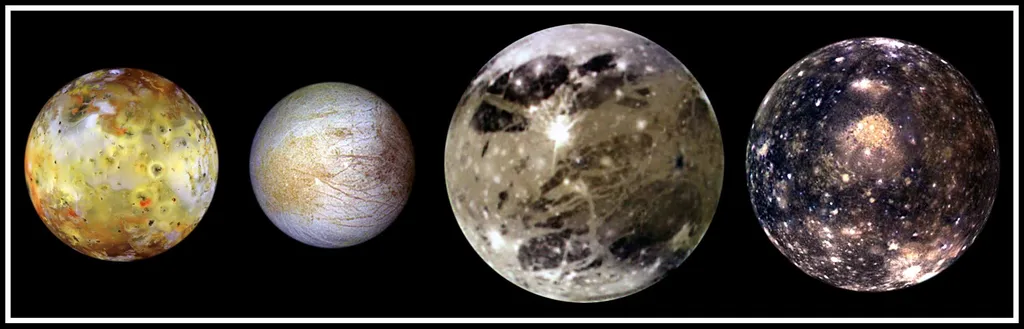
There is a moon where the ground rises and falls like a tide, by the height of a tall building. A moon that sprays its hidden ocean into space, for free. A moon with rivers, lakes and seas, where the rain is not water.
Hundreds of moons orbit the planets, Pluto included, and the count keeps climbing. Most are forgettable. Some are gloriously strange. So we ranked them, and the moon you expect to win does not.
How we scored them
Nothing here is a matter of taste. Every moon, or group of moons, faces 20 tests[1], grouped into four categories:
- Is it geologically alive right now?
- How strange is its orbit?
- How strange is its shape or its surface?
- Does it have air or liquid?
Then one more question: how many other moons share its signature trait? A trait nothing else has scores the maximum, and that rarity score counts double. The scores add up to a single total, and the total decides the order. Every row has sources, and the scoring table is public. The ranking covers 29[2] entries, because a few of them are pairs or whole families of moons that only make sense together.
Where two entries finish on the same total, the published table breaks the tie, so the order on this page is the order in the table.
The lightning round, #29 to #16
Fourteen entries scored low enough to share a single quick list. Four of them rest on thin evidence, and the table marks them low confidence: Mimas, Amalthea, Hippocamp and Daphnis. We have worded each of those carefully.
- #29, the moons of dwarf planets and asteroids. Hundreds of them, and almost nothing is measured about most.
- #28, Uranus's big four. Tipped on their sides, so each pole spends decades in darkness at a stretch.
- #27, the irregular captured moons. Captured rocks, most of them orbiting backwards. (This one is tied with the entry above it.)
- #26, Hippocamp. Probably a chip knocked off a bigger moon. Nobody has seen it as more than a dot.
- #25, Amalthea. A red rubble pile that may be about as dense as water, or less.
- #24, Phoebe. Orbits backwards and sheds a vast ring of its own.
- #23, Callisto. Billions of years of craters, barely touched, and an ocean nobody can confirm.
- #22, Uranus's inner moons. Packed so tightly that some are expected to collide.
- #21, Deimos. Its craters are half buried under its own dust.
- #20, Miranda. Looks assembled from spare parts, with an enormous cliff.
- #19, Mimas. The Death Star moon, and possibly hiding an ocean.
- #18, Pan and Atlas. A walnut and a flying saucer, each wearing a ring it built itself.
- #17, Nix and Hydra. Tumbling so chaotically that nobody can tell you where the Sun will rise.
- #16, Methone. A smooth cosmic egg with no large craters.
#15, Earth's Moon
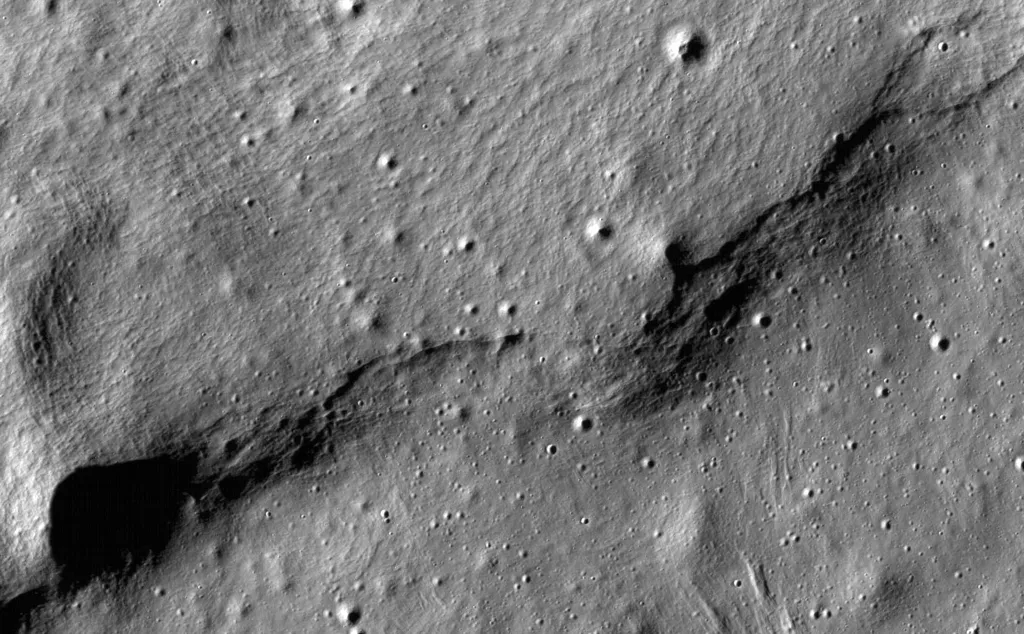
You expected it lower. So did we. But the Moon is not finished. Orbiting cameras photographed the same ground twice and found new impact craters that formed while they were watching. Its surface is cut by young cliffs, where the cooling interior is shrinking and the crust is buckling. Apollo's seismometers caught quakes clustered along those same faults. And on the far side lies a basin so large it covers a big share of the whole hemisphere.
#14, Daphnis
A tiny chip of ice, a few kilometres wide and far less dense than water. As it ploughs along the edge of a gap in Saturn's rings, its gravity pulls the ring edge into standing waves. Estimates of how tall those waves rise disagree, and the table marks this one low confidence, but they are tall by any measure. A moon you could walk across in an afternoon, raising mountains out of a ring.
#13, Tethys, Dione and Rhea
Tethys carries a crater that spans a large part of its width. But the strangeness is the company they keep. Tethys and Dione each have two tiny moons locked in the same orbit, one riding ahead and one behind, held there for good. Rhea has none. Nobody knows why.
#12, Charon
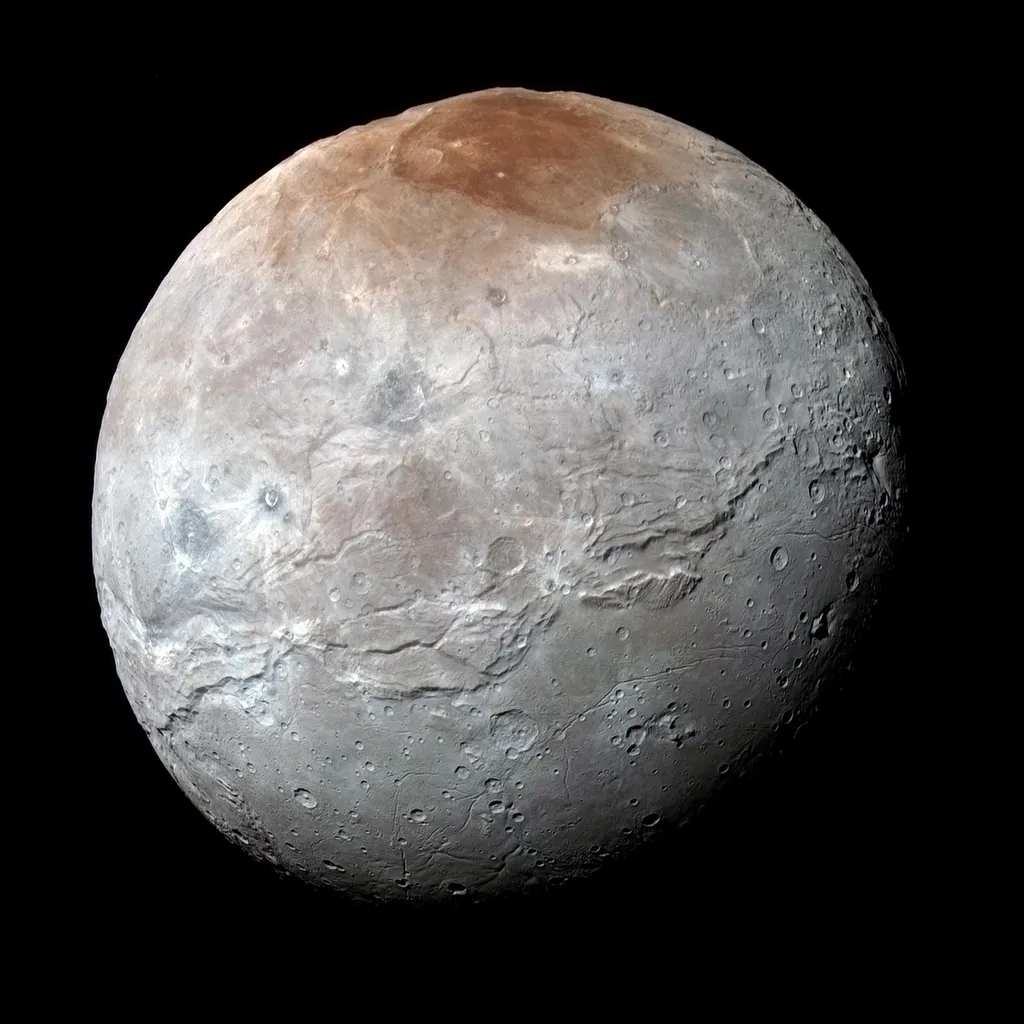
Charon is about half the width of Pluto. It is so big that the two do not orbit the usual way. They circle a point in empty space between them, locked face to face. And then there is the red cap on Charon's pole: gas escaping Pluto drifts across, freezes on Charon's winter pole, and ultraviolet light cooks it into a reddish stain. One world, slowly staining another.
#11, Europa
A cracked white shell of ice, scarred reddish-brown, with a salty ocean underneath that may hold more water than all of Earth's oceans put together. Jupiter's gravity flexes Europa every orbit, and that flexing keeps the water liquid. Its surface is young in geological terms. Liquid water, energy and chemistry are all on the list. NASA's Europa Clipper is on its way to look closer. We make no claim about plumes: they are possible, and later observations have not confirmed them.
#10, Janus and Epimetheus
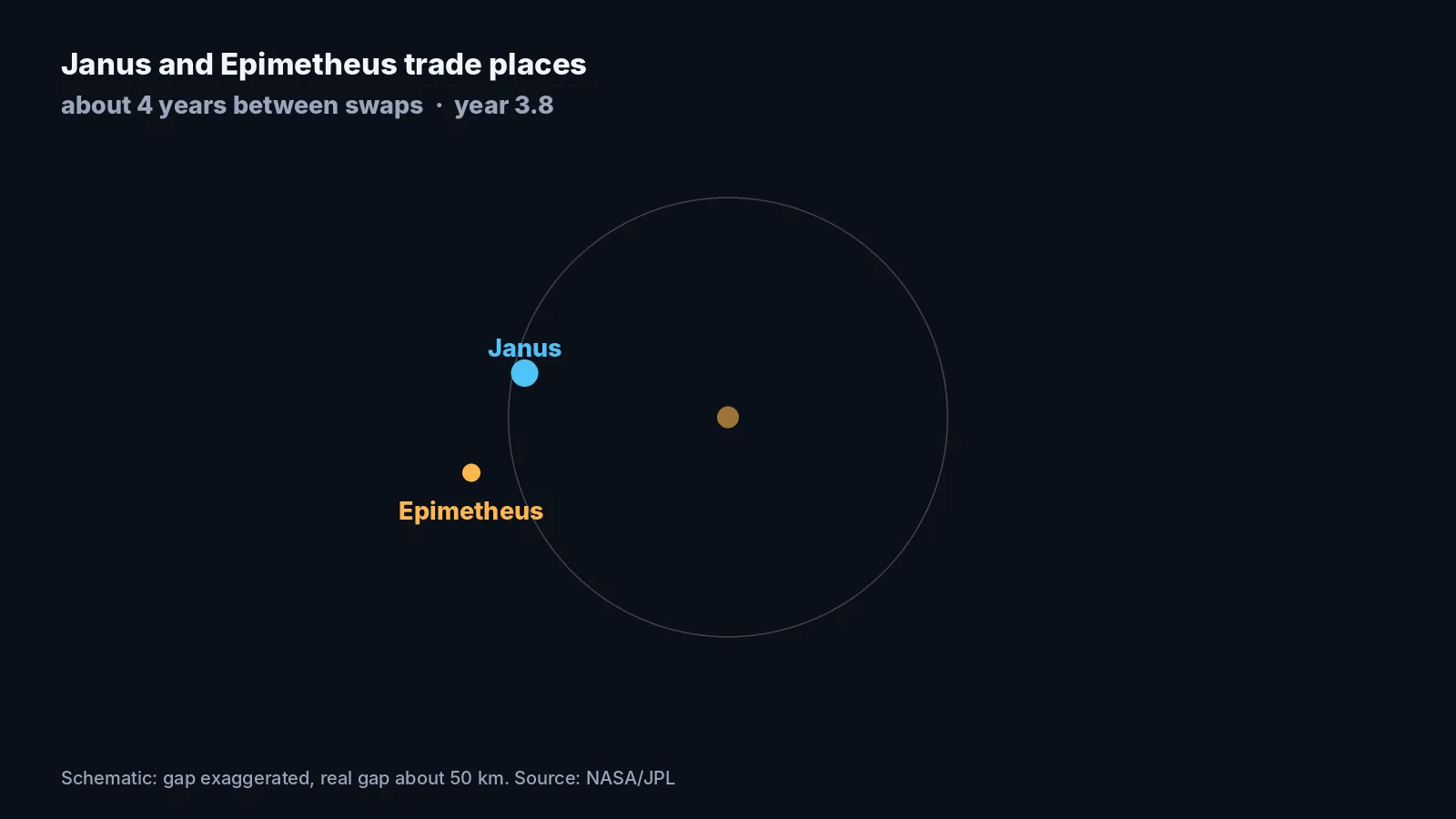
Two moons sharing almost the same orbit, a short distance apart. The inner one moves faster, so it slowly catches up. You would expect a collision. Instead their gravity tugs, the inner moon is lifted, the outer one is dropped, and they swap places. Then they drift apart again. NASA calls it the only orbital arrangement like it known anywhere.
#9, Phobos
Mars's larger moon circles the planet several times a day, so from the surface it rises in the west. One crater takes up a large share of its width, and the impact nearly destroyed it. It is also losing the race against Mars: it creeps closer every century, and in the end Mars will tear it apart and gain a ring.
#8, Nereid
No spacecraft has ever seen its surface. It is a dot. But Nereid holds a record no other moon comes close to: its orbit is so lopsided that its distance from Neptune changes roughly sevenfold every time it goes round. It was probably flung there when Triton arrived, a survivor of a catastrophe we can still measure.
#7, Iapetus
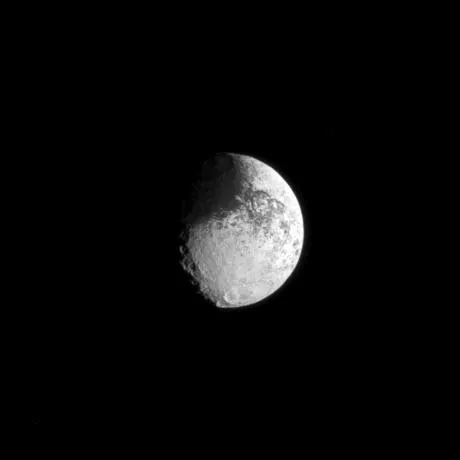
In the seventeenth century, Giovanni Cassini found a moon of Saturn he could see on only one side of the planet. On the other side it vanished. One hemisphere of Iapetus is dark as coal, the leading one, and the other is bright as snow, many times brighter. Running right around its equator is an enormous ridge, giving the whole moon the look of a walnut. Nobody is certain how it formed.
#6, Hyperion
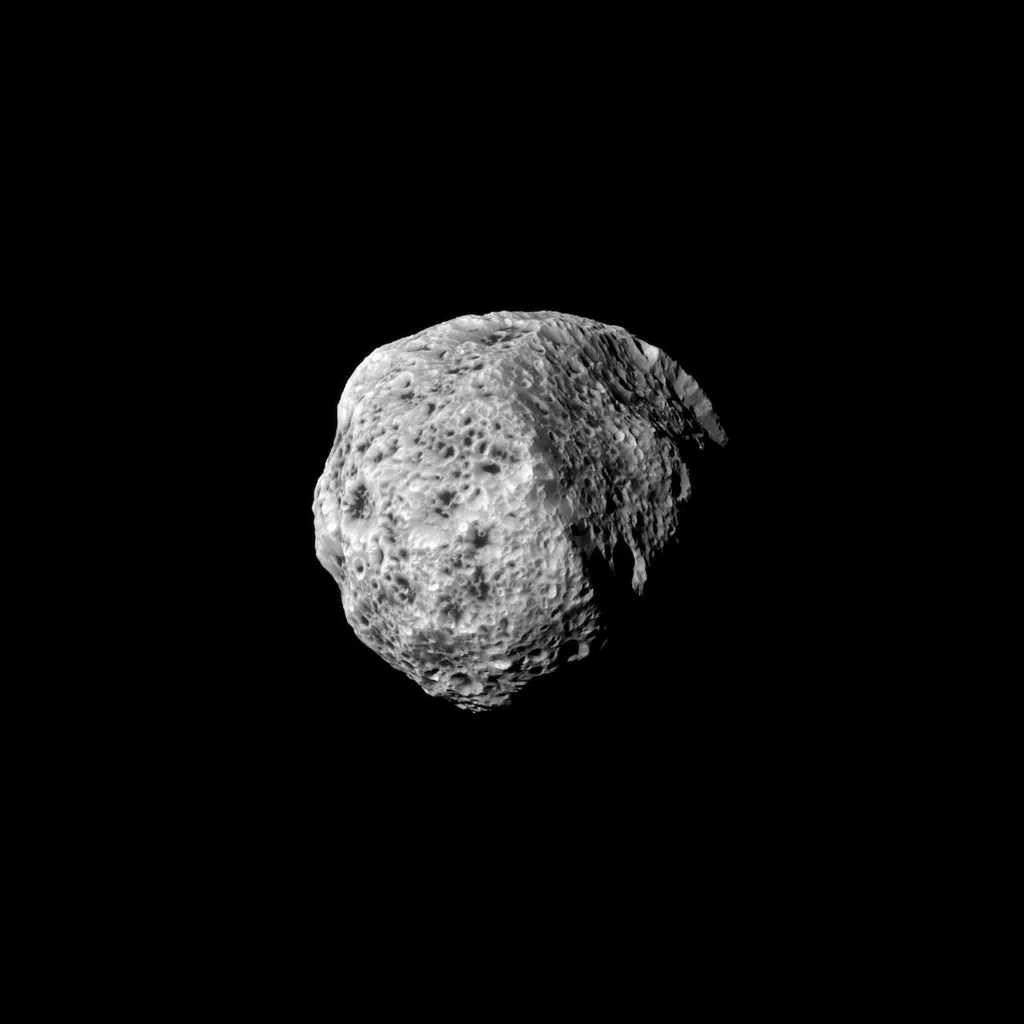
It looks like a sponge, riddled with deep, sharp-edged pits, because a big part of Hyperion is empty space. It is so porous that impacts punch into it instead of blasting material out. But the real strangeness is the spin. Hyperion tumbles chaotically, nudged by Titan's gravity, and it is one of very few moons confirmed to do it. You could not say which way it will face next year.
#5, Ganymede
The largest moon in the solar system, bigger than the planet Mercury. But size is not what puts it here. Ganymede is the only moon known to generate its own magnetic field, which means it has its own auroras. Watching those auroras rock back and forth, astronomers worked out that a buried saltwater ocean must be pushing against Jupiter's field. Europe's JUICE spacecraft is on its way to find out more.
#4, Triton
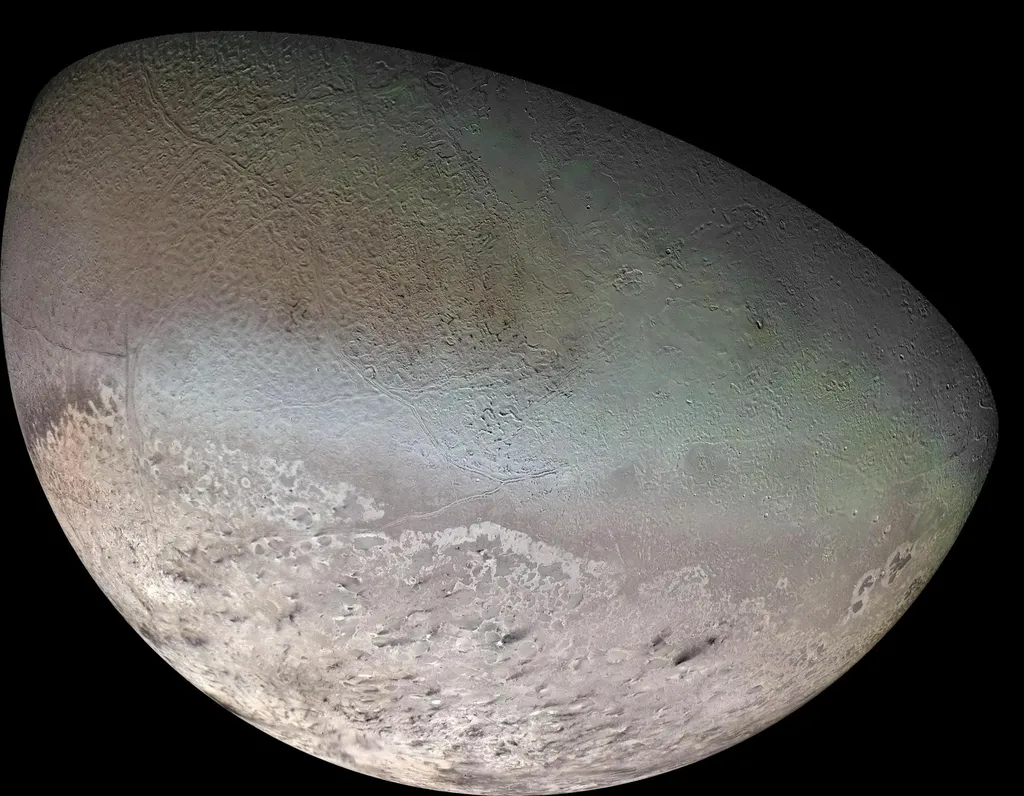
Every large moon in the solar system orbits in the direction its planet spins. Except this one. Triton goes backwards, because it was never Neptune's to begin with. It was a world from the Kuiper Belt, a cousin of Pluto, captured long ago. Voyager 2 saw plumes there.
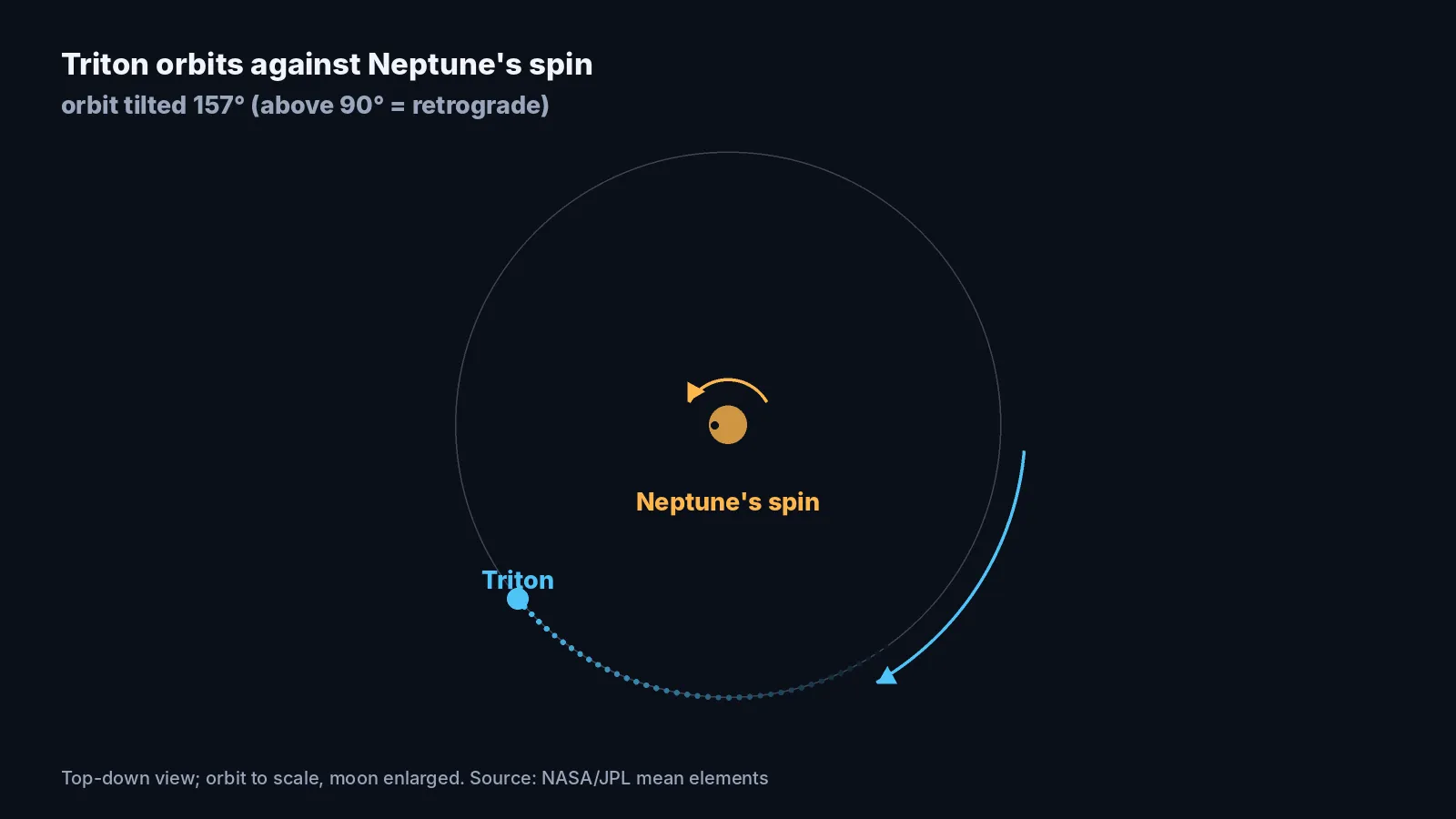
So why only fourth? When we checked, the things everyone assumes about Triton are not established. Its surface is a few hundred million years old, not brand new. Its atmosphere has not measurably changed since Voyager 2 flew past. And its ocean is a candidate, not a finding. Triton is the moon we want to be alive.
#3, Enceladus
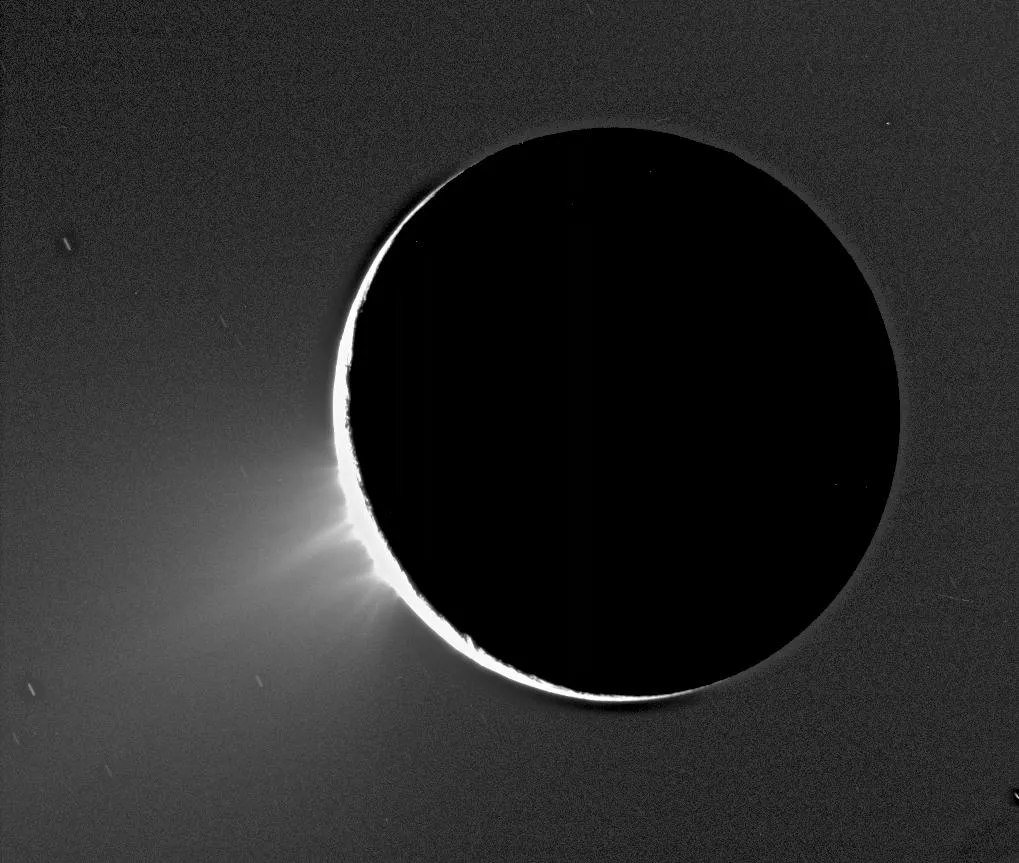
It is tiny, and it should be a frozen, dead ball of ice. Instead, jets fire water into space from long cracks near its south pole, as reported by Porco and colleagues in 2014. The water comes from an ocean under the ice, and the spray is so constant that it builds an entire ring of Saturn. Cassini flew straight through those plumes and tasted them: salts, silica, organic molecules, and hydrogen gas, the last reported by Waite and colleagues in 2017. A moon that hands us samples of its ocean, for free.
#2, Titan
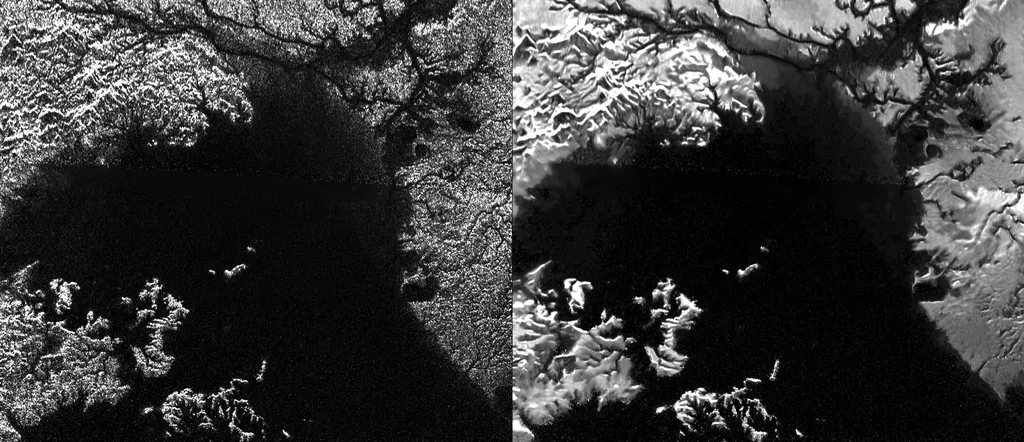
The only moon with a thick atmosphere, with more pressure than at sea level on Earth and made almost entirely of nitrogen, like our own. It rains on Titan. There are rivers, lakes and seas. But the liquid is methane and ethane, at a temperature far below freezing. Cassini watched bright patches appear and vanish in one of those seas, and nobody has settled what they were. Under it all, a water ocean sits deep underground. Titan comes second, and it still is not first.
#1, Io
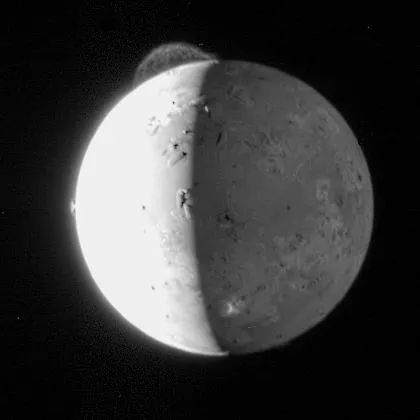
Io is the most volcanically active world in the solar system: hundreds of active volcanoes, lava fountains many kilometres high, and plumes of sulfur reaching far into space. The surface is repainted so often that it has almost no impact craters, and a spacecraft recently found a volcano that simply was not there the last time anyone looked.
Why? Io is caught in a gravitational tug of war between Jupiter and two of its neighbours. They keep its orbit slightly oval, so Jupiter's gravity stretches and squeezes it again and again, and the solid ground rises and falls by a huge amount. Io is the only moon to score full marks for being alive. This is what happens when a world is never allowed to rest.
Where we could be wrong
We expected Triton to win. The numbers said fourth, so fourth is where it goes. Every score is public. If you think we got a flag wrong, tell us which one, and show your source. We will rerun the whole table.
If you want to feel how big these worlds really are, the next video puts them all to scale.
Data and sources
- total tests (calculated from the sources above)
- total moons (calculated from the sources above)
Every number in the video is in the open data table (CC BY 4.0).
Image credits
- Lobate Scarps on the Moon: NASA (source)
- Charon in Enhanced Color: NASA/Johns Hopkins University Applied Physics Laboratory/Southwest Research Institute (source)
- Yin Yang Iapetus: NASA/JPL/Space Science Institute (source)
- Spongy Hyperion: NASA/JPL-Caltech/Space Science Institute (source)
- Global Color Mosaic of Triton: NASA/JPL/USGS (source)
- Fountains of Enceladus: NASA/JPL/Space Science Institute (source)
- Despeckling Ligea Mare: NASA/JPL-Caltech/ASI (source)
- Tvashtar Plume: NASA/Johns Hopkins University Applied Physics Laboratory/Southwest Research Institute (source)
- The Galilean Satellites: NASA/JPL/DLR (source)