Voyager 1 Is Now One Light-Day Away. 3 Years Ago, One Dead Chip Almost Ended the Mission
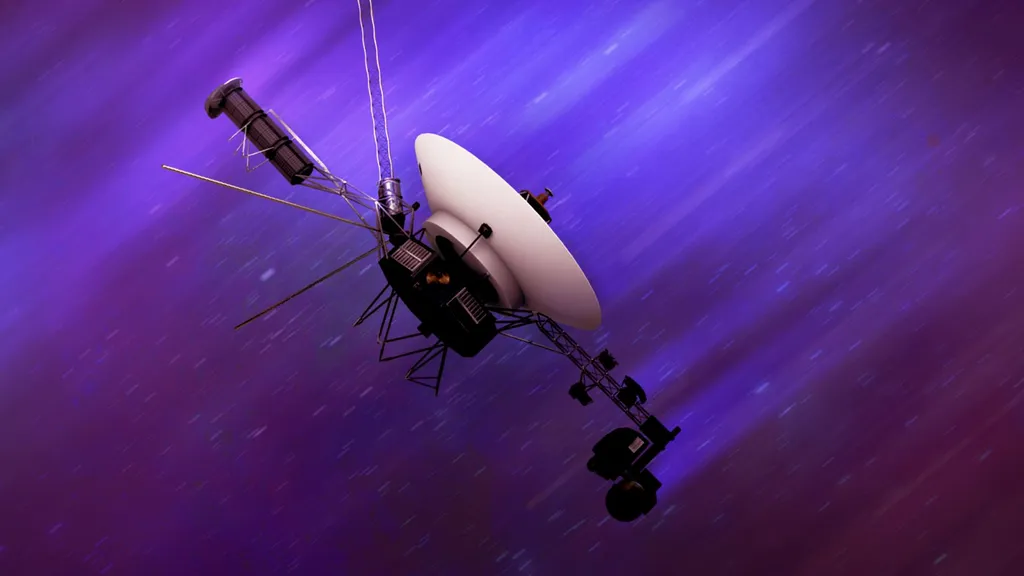
On 14 Nov 2023[1], the most distant machine humans have ever built started talking nonsense.
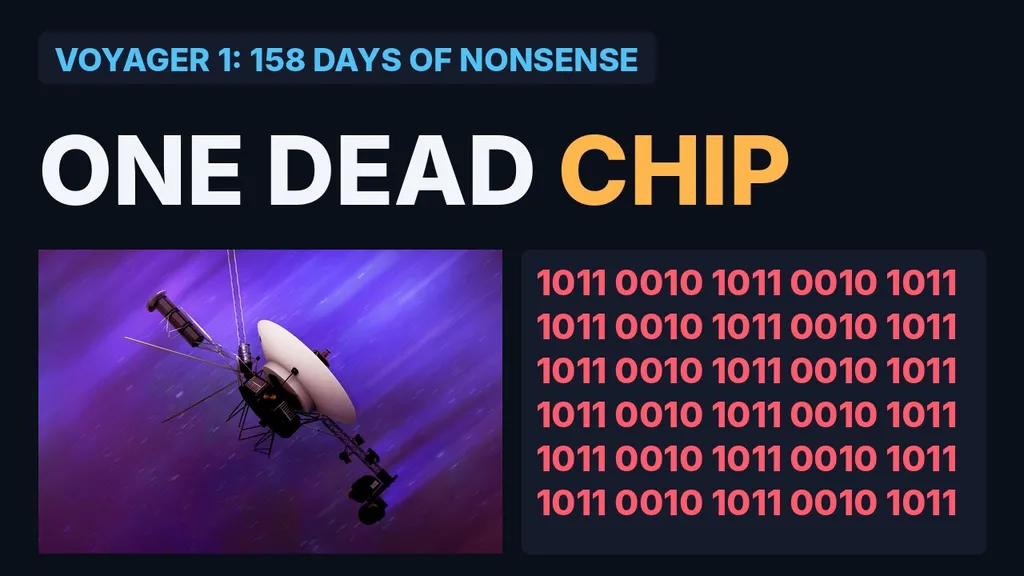
Voyager 1 was still there. Its radio was still on, and it still did what it was told. But everything it sent home was a meaningless pattern of ones and zeros, and for 158 days[2] nobody on Earth could read a word of it. Its own project manager doubted they would ever get it back.
This is the story of how a small team brought it back, one command at a time, on a computer built in the 1970s — and of the line Voyager 1 has now crossed that nothing made by humans has crossed before.
One light-day
In a single day, light covers 25.902 billion km[3]. That is about 16.094 billion miles[4], or 173.14 AU[5], and the distance has a name: one light-day.
At 2026-11-18 10:16:07 UTC[6], Voyager 1 reached it — the first human-made object to reach 1 light-day[7]. It launched on 5 Sep 1977[8], swung past Jupiter and Saturn, and has been coasting outward ever since at roughly 38000 mph[9].
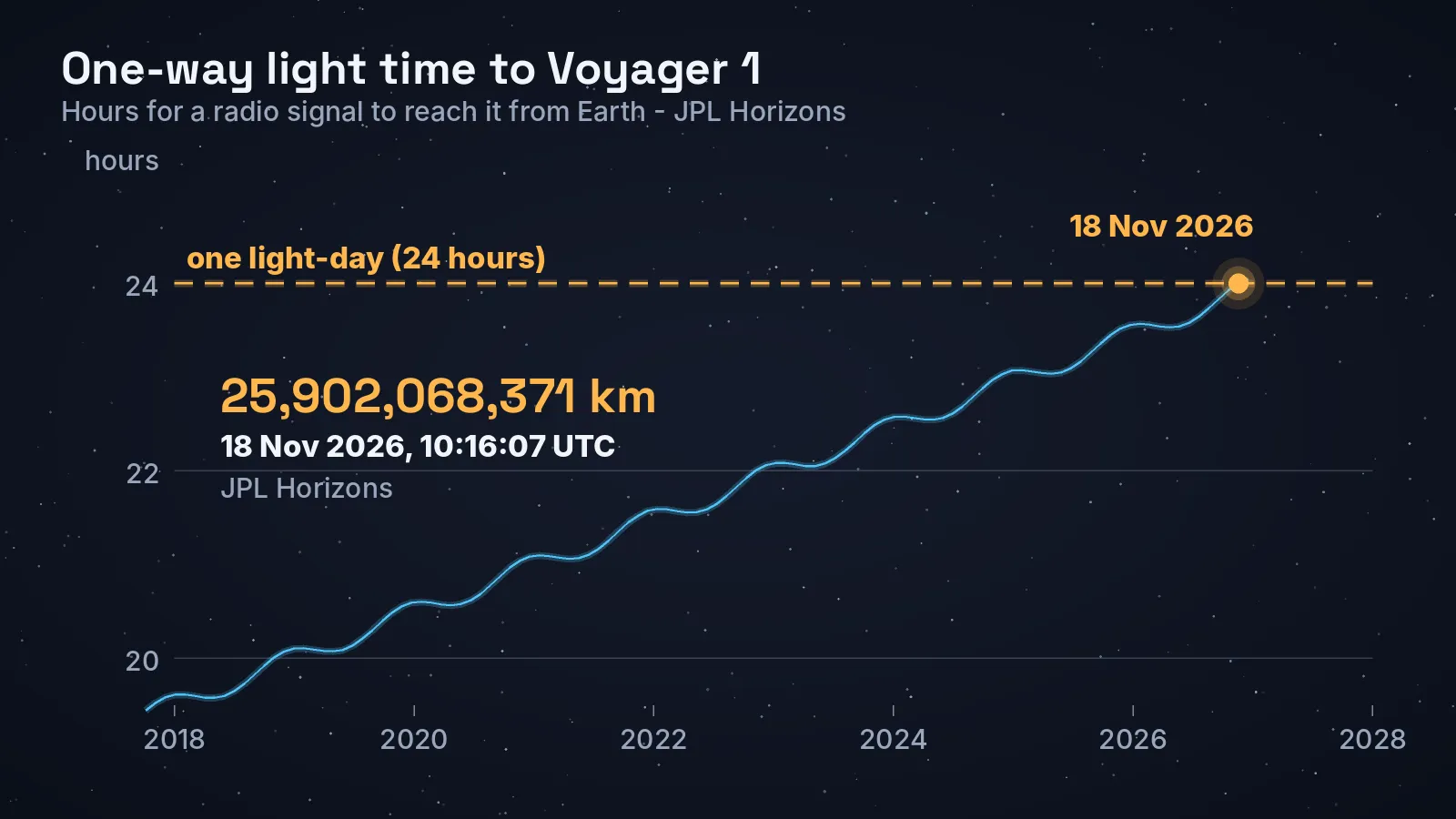
Look closely at the line. The small ripples in it are not Voyager. They are us: once a year Earth swings around the Sun, a little towards the spacecraft, then away again.
One light-day means something very practical. Send Voyager a simple "Hi" today and it arrives tomorrow. The earliest you could hear anything back is the day after — a round trip of 48 hours[10]. As the project manager, Suzanne Dodd, puts it:
If you want to say 'hello' to Voyager, you send your message and then you go home…[11]
Now imagine fixing a broken computer that way.
The machine
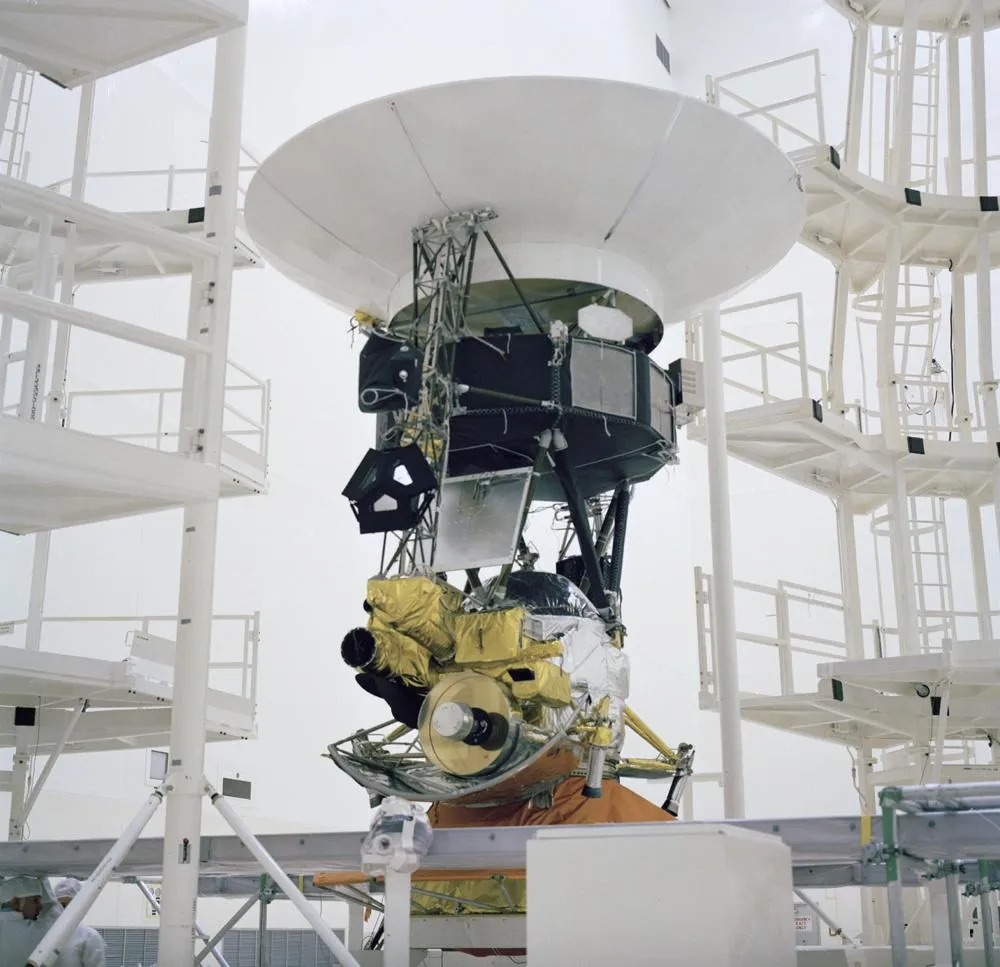
Voyager 1 weighs 815 kg[12]. It has no solar panels; out there the Sun is far too faint. Instead 3 RTGs[13] turn the heat of decaying plutonium into electricity. At launch they produced 475 W electrical (from 7000 W heat)[14], and they lose about 4 W per year[15].
Everything Voyager learns leaves through one dish, 3.7 m[16] across, at a normal rate of 160 bits/s[17] — far slower than an old dial-up modem.
Inside are 3 onboard computers: CCS (commands), AACS (attitude/pointing), FDS (packages data)[18]. The third is the one this story is about: the flight data subsystem. It gathers the readings from the science instruments, adds engineering data about the spacecraft's own health, and packs it all into a single package. A separate unit turns that package into the radio signal sent to Earth.
If the packing goes wrong, the radio keeps working perfectly. It just carries nonsense.
Talking nonsense
That is exactly what happened. Engineers could see Voyager's signal arriving on schedule, and they could tell it was still receiving their commands. But the unit that sends the data home was repeating the same pattern of ones and zeros, over and over, as if it were stuck.
So the team did what anyone does with a frozen computer. In December they restarted the flight data subsystem and tried to put it back in the state it had been in before the problem began. Then they waited: 22.5 hours[19] for the command to go out, and as long again for any answer to come home.
Nothing changed. By early 2024 the mood was grim, and Dodd told the website Ars Technica:
It would be the biggest miracle if we get it back.[20]
Think about the trap they were in. When a computer fails, you read its error messages. But the only way Voyager could tell them what was wrong was through the very part that was broken.
The poke
So instead of a fix, they tried a nudge. On 1 Mar 2024[21] they sent a command the team called a poke. It gently prompted the flight data subsystem to run through different sequences in its software, in the hope that one of them would step around whatever was damaged.
On 3 Mar 2024[22], something changed. One section of the output looked different from the stuck pattern. It still was not in the normal format, but it was not noise either. Engineers decoded it over the following days (7-10 Mar 2024[23]), and an engineer with NASA's Deep Space Network worked out what they were looking at: a readout of the flight data subsystem's entire memory. Its software. Its variables. Everything.
For the first time in almost four months, they could see inside.
One dead chip
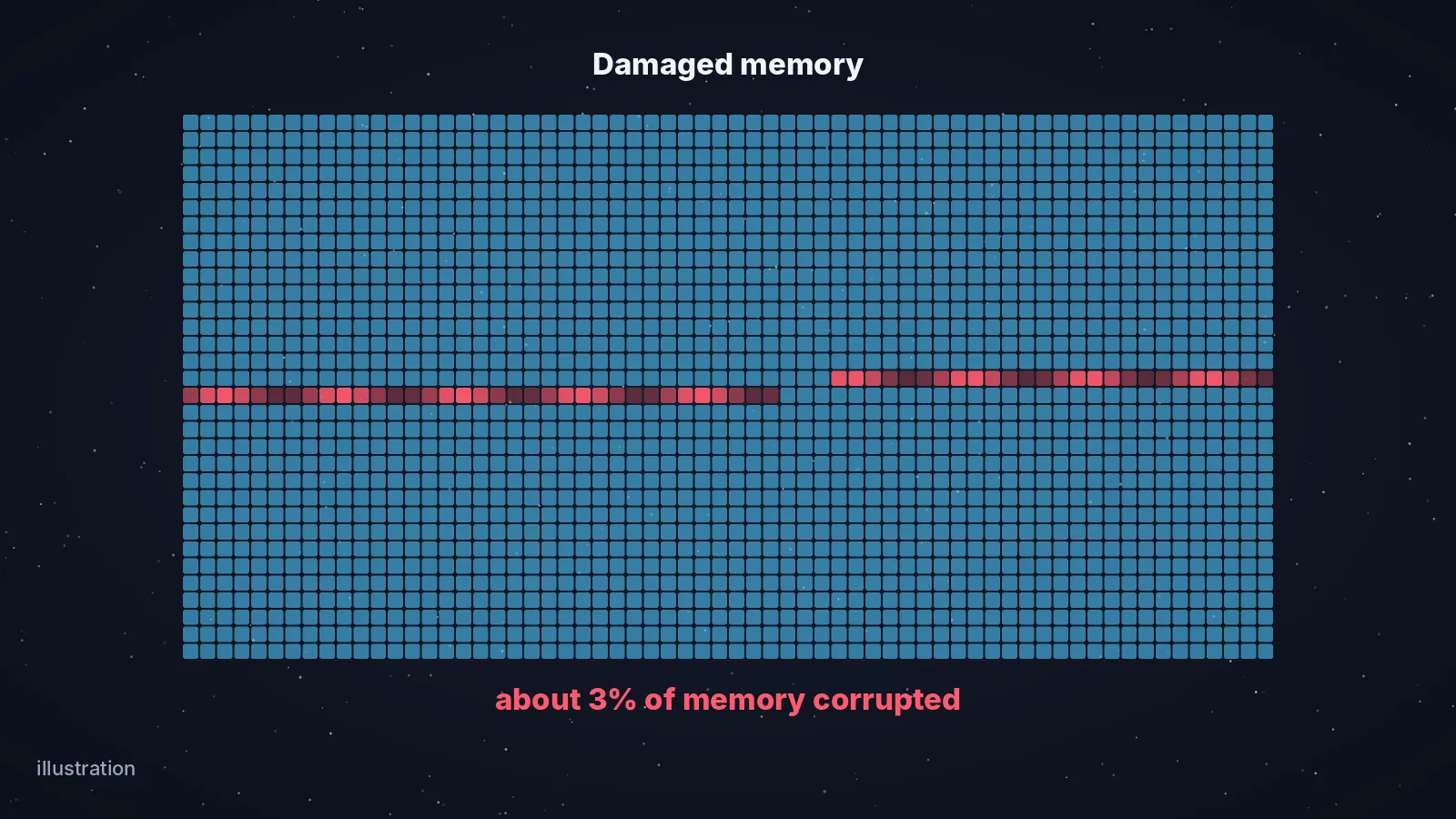
Using that readout, the team found the damage. It was small, and it was exact: 3 % of FDS memory[24] was corrupted.
The likely cause was a single chip that stored part of that memory and had stopped working. NASA says it cannot know for certain. The chip may have been hit by an energetic particle from space, or it may simply have worn out after decades in flight. Either way it could not be repaired — and part of the software that packages Voyager's data had been stored on it.
The fix
That code needed a new home somewhere else in the same computer's memory, and there was a catch: no single free space was large enough to hold it.
Think of moving house and finding no other house big enough for all your furniture. So you split it up — some pieces here, some there — and you leave a note in every room saying where everything went. That is what the team did. They cut the code into sections, stored each one in a different part of memory, made sure the sections still worked together as a whole, and updated every other part of the software that pointed to the old location.
Whatever they sent would run on a spacecraft they could not see and could not reach, far beyond the planets. They started with one piece: the code that packages the engineering data, the spacecraft's report on its own health. They sent it on 18 Apr 2024[25].
Readable again
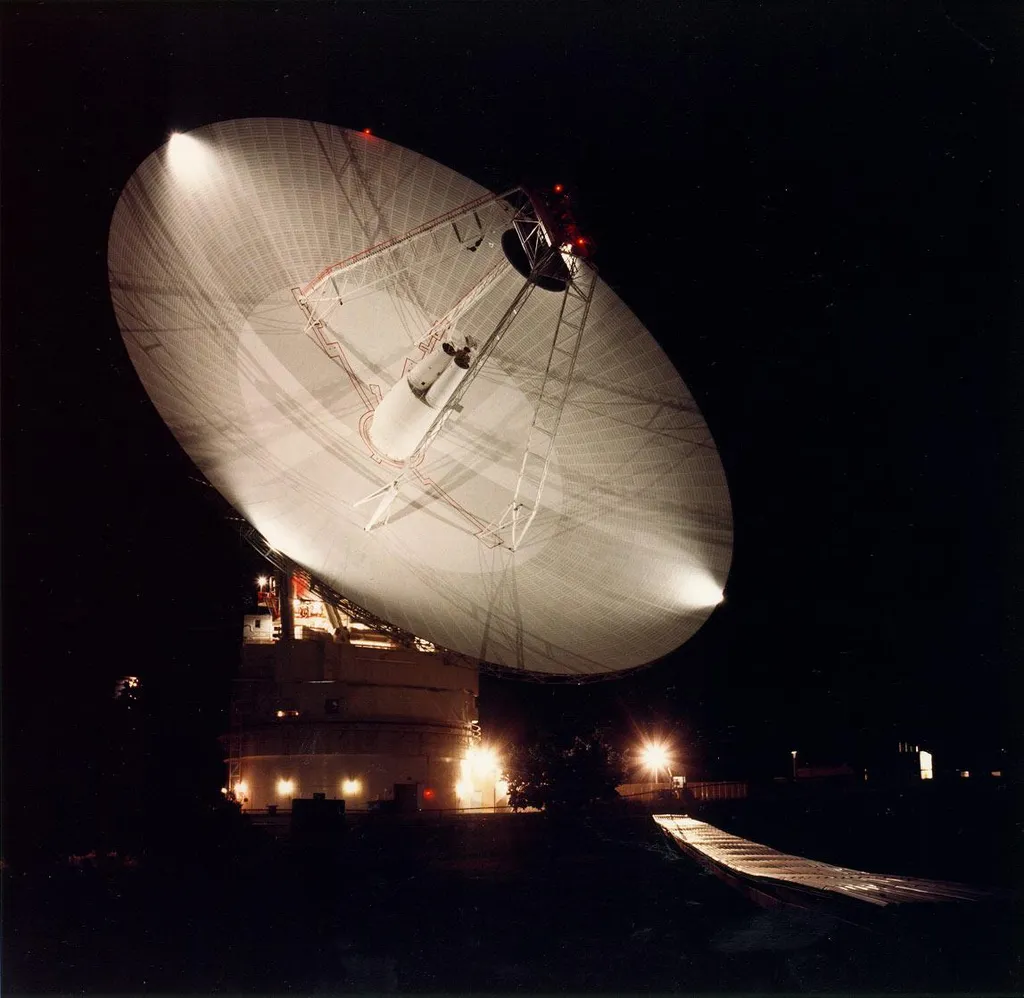
Then came the longest part of any Voyager repair: waiting.
On 20 Apr 2024[26], the answer came. Readable data. For the first time in five months, the team could check the health of their spacecraft. 158 days[2] after it started talking nonsense, Voyager 1 made sense again.
Science came next. On 19 May 2024[27] they sent the command to resume science data, and two of the four working instruments came straight back. The other two needed more work. By 13 Jun 2024[28], all four were sending usable data.
The mission was back. But Voyager was not finished surprising them.
It keeps happening
This was not the first time, and it would not be the last.
2022. The computer that keeps Voyager pointed at Earth began sending garbled reports about itself, while working normally. It had started routing its data through another onboard computer, one known to have stopped working years earlier. The fix was a single command: use the right computer.
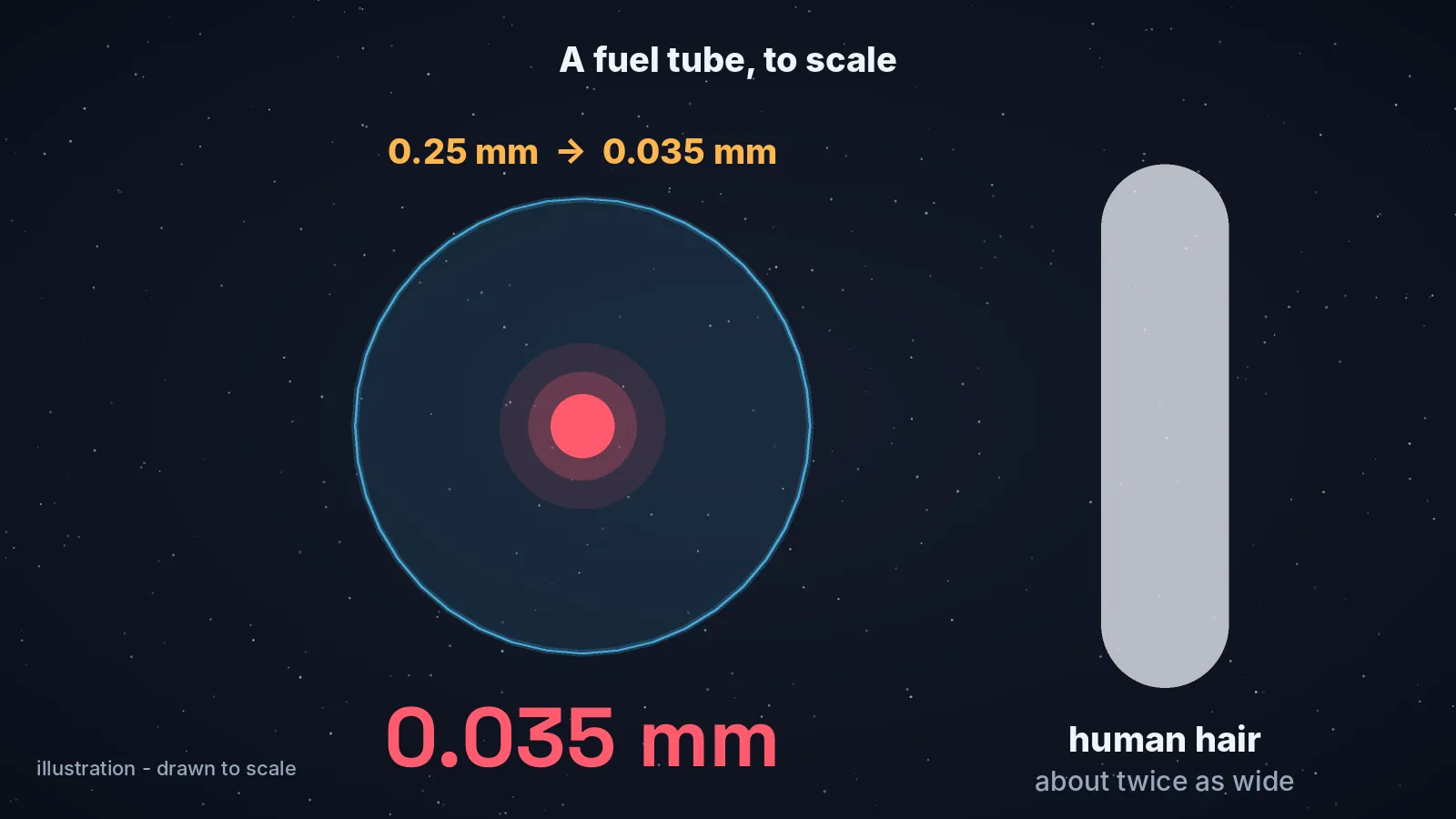
2024, August. Voyager steers with tiny thrusters that fire puffs of fuel lasting a few hundredths of a second. Over the decades, silicon dioxide shed by a rubber diaphragm in the fuel tank had been clogging their fuel tubes. One opening, once 0.25 mm[29] wide, had narrowed to 0.035 mm[30] — about half the width of a human hair. The team switched to a different set of thrusters.
2024, October. A routine command to turn on a heater, sent on 16 Oct 2024[31], tripped Voyager's automatic fault protection. The spacecraft shut down its usual transmitter and switched to a backup radio it had not used to talk to Earth in decades. For a while it seemed to have gone quiet. Then the Deep Space Network picked up a much fainter signal, confirmed on 22 Oct 2024[32].
2025. Voyager's main roll thrusters had been dead since 2004[33], after two small heaters lost power, and had been written off as unfixable. Engineers came to suspect that a glitch had simply flipped a switch to the wrong position. Testing that was a gamble: if the thrusters fired while still cold, it could cause a small explosion. On 20 Mar 2025[34] the heaters warmed up, and thrusters written off for more than twenty years were working again.
And all the while, the power keeps falling. Voyager 1 launched with 10 instruments[35]. What still returns data today: 2 plasma wave + magnetometer[36]. In early Sep 2026[37] the team swapped several devices for lower-power ones in a single move they called the Big Bang, to keep the last instruments running longer.
Still listening

Then came two days of silence (18-19 Oct 2026[38]): the Deep Space Network listened for Voyager 1 and heard nothing at all. On 20 Oct 2026[39] the signal came back. One group of thrusters had gone offline, and the spacecraft had switched to its backups on its own. Why, the team still does not know. Their mission manager, Kareem Badaruddin, said:
This is the first time we've seen the spacecraft do something like this…[40]
One month later, Voyager 1 crossed one light-day. So the next time it goes quiet, or starts talking nonsense, the team will wait a full day for each message to arrive, and another full day for each answer.
The power will not last forever. Its twin, Voyager 2, reaches the same line only years from now (2035-11[41]), and will most likely have fallen silent by then.
But right now, one light-day from here, a machine built in the 1970s is still listening for our commands, and a small team on Earth still knows how to talk to it.
One day, it will stop answering. And because of the distance, by the time its last signal reaches us, Voyager 1 will already have been silent for a full day. We will not know it is gone until at least a day after it is gone.
Data and sources
- www.jpl.nasa.gov/news/nasas-voyager-1-resumes-sending-engineering-updates-to-earth
- days unreadable (calculated from the sources above)
- science.nasa.gov/mission/voyager/where-are-voyager-1-and-voyager-2-now
- science.nasa.gov/mission/voyager/where-are-voyager-1-and-voyager-2-now
- earthsky.org
- science.nasa.gov/mission/voyager/where-are-voyager-1-and-voyager-2-now
- earthsky.org
- earthsky.org
- www.sciencedaily.com/releases/2026/11/261103003152.htm
- www.sciencedaily.com/releases/2026/11/261103003152.htm
- www.sciencedaily.com/releases/2026/11/261103003152.htm
- pds-rings.seti.org/voyager/rss/vg1host.html
- pds-rings.seti.org/voyager/rss/vg1host.html
- pds-rings.seti.org/voyager/rss/vg1host.html
- science.nasa.gov/blogs/voyager/2026/04/17/nasa-shuts-off-instrument-on-voyager-1-to-keep-spacecraft-operating
- science.nasa.gov/mission/voyager/spacecraft
- science.nasa.gov/mission/voyager/spacecraft
- science.nasa.gov/mission/voyager/spacecraft
- science.nasa.gov/blogs/voyager/2024/03/15/nasa-engineers-make-progress-toward-understanding-voyager-1-issue
- petapixel.com/2024/02/08/nasa-engineers-are-desperately-trying-to-save-voyager-1-the-most-distant-spacecraft-ever
- science.nasa.gov/blogs/voyager/2024/03/15/nasa-engineers-make-progress-toward-understanding-voyager-1-issue
- science.nasa.gov/blogs/voyager/2024/03/15/nasa-engineers-make-progress-toward-understanding-voyager-1-issue
- science.nasa.gov/blogs/voyager/2024/03/15/nasa-engineers-make-progress-toward-understanding-voyager-1-issue
- science.nasa.gov/blogs/voyager/2024/04/04/engineers-pinpoint-cause-of-voyager-1-issue-are-working-on-solution
- www.jpl.nasa.gov/news/nasas-voyager-1-resumes-sending-engineering-updates-to-earth
- www.jpl.nasa.gov/news/nasas-voyager-1-resumes-sending-engineering-updates-to-earth
- science.nasa.gov/blogs/voyager/2024/06/13/voyager-1-returning-science-data-from-all-four-instruments
- science.nasa.gov/blogs/voyager/2024/06/13/voyager-1-returning-science-data-from-all-four-instruments
- www.jpl.nasa.gov/news/voyager-1-team-accomplishes-tricky-thruster-swap
- www.jpl.nasa.gov/news/voyager-1-team-accomplishes-tricky-thruster-swap
- science.nasa.gov/blogs/voyager/2024/10/28/after-pause-nasas-voyager-1-communicating-with-mission-team
- science.nasa.gov/blogs/voyager/2024/10/28/after-pause-nasas-voyager-1-communicating-with-mission-team
- science.nasa.gov/blogs/voyager/2025/05/14/nasas-voyager-1-revives-backup-thrusters-before-command-pause
- science.nasa.gov/blogs/voyager/2025/05/14/nasas-voyager-1-revives-backup-thrusters-before-command-pause
- science.nasa.gov/blogs/voyager/2026/04/17/nasa-shuts-off-instrument-on-voyager-1-to-keep-spacecraft-operating
- science.nasa.gov/blogs/voyager/2026/04/17/nasa-shuts-off-instrument-on-voyager-1-to-keep-spacecraft-operating
- science.nasa.gov/blogs/voyager/2026/10/29/nasas-voyager-1-conserves-power-resolves-brief-communications-pause
- science.nasa.gov/blogs/voyager/2026/10/29/nasas-voyager-1-conserves-power-resolves-brief-communications-pause
- science.nasa.gov/blogs/voyager/2026/10/29/nasas-voyager-1-conserves-power-resolves-brief-communications-pause
- www.sciencedaily.com/releases/2026/11/261103003152.htm
- earthsky.org
Every number in the video is in the open data table (CC BY 4.0).